Ludovic Bergeron

Making ML modelsexplainable enoughto trust.

I'm Ludovic Bergeron, a final-year engineering student at ESIEA (MSc level, AI & Data Science) and a student researcher at esiealab, where I work on making deep reinforcement learning controllers for type 1 diabetes explainable enough to reach a clinic. Before that I ran an open-ended applied research project at the AI Factory of Christian Dior Couture, on product similarity for recommendation.

Looking for a research internship and then a PhD in machine learning.

Closed-loop insulin delivery: the measured signal, its target band, and the dose the controller chooses.

Research

Two projects: one running now, one finished. Each is described by what it asks, how it is evaluated, and what it would take to be believed.

In progress

Advisor
Dr. Mélanie Piot
Place
Paris, France

Explaining deep-RL insulin controllers through causal inference

esiealab, ESIEA

Deep reinforcement learning controllers for closed-loop insulin delivery perform well, but a clinician cannot see why they act. I infer which factor drives each glucose deviation — a meal, stress, the hormonal cycle — using anti-causal inference, then feed that factor back into the loop as an interpretable control variable. The aim is to lift the black-box barrier that keeps these controllers out of clinical deployment.

Methods
Deep reinforcement learning, causal and anti-causal inference, interpretable control, glucose dynamics simulation
Completed

Role
Applied ML Research Intern
Place
Paris, France

Product similarity for recommendation, learned from metadata

Christian Dior Couture, AI Factory

An open-ended R&D brief with no predefined objective: I framed the problem statement and the research direction myself, from loosely defined business needs. I surveyed the recommendation literature and implemented a Prod2Vec / Meta-Prod2Vec recommender — skip-gram with negative sampling — as a first baseline. I then engineered product metadata as side information, pairing exploratory visual analysis with product-domain expertise, and benchmarked configurations under a rigorous offline protocol (HR@K, NDCG@K, MRR, coverage@K) to isolate the attributes that genuinely improved ranking quality.

Methods
Prod2Vec, Meta-Prod2Vec, skip-gram with negative sampling, offline ranking evaluation, UMAP, spectral clustering

Covered by a confidentiality agreement. The problem framing, the method and the evaluation protocol are described here; the data, the product names and the figures are not.

Selected work

Systems I built end to end, where the constraint — a phone with no network, a clinical cohort, a product that ships — did most of the teaching.

Built solo for the Google DeepMind Gemma 4 Good hackathon

Built with
Keras, MediaPipe, TFLite / LiteRT, Gemma 4 E2B, Android

Sign2Speak

A fully on-device American Sign Language translator. 50 signs, extensible to 250, with no server round-trip — for privacy and for offline use.

I trained a custom Conv1D + Transformer sign classifier in Keras on the Kaggle ISLR dataset (~94k sequences, 543 landmarks per frame) and exported it to TFLite via LiteRT for on-device inference. The edge pipeline runs end to end on the phone: CameraX captures the signer, MediaPipe extracts hand and face landmarks, the TFLite classifier produces ASL gloss, Gemma 4 E2B (LiteRT-LM, on-device) turns that gloss into fluent English, and Android text-to-speech says it out loud.

The system running end to end, on the phone.

Project notesKaggle write-upSource code on GitHub

On the App Store, Android coming soon to Google Play

Built with
Flutter, Supabase, Mistral (tool calling), QLoRA / Unsloth

Loodo

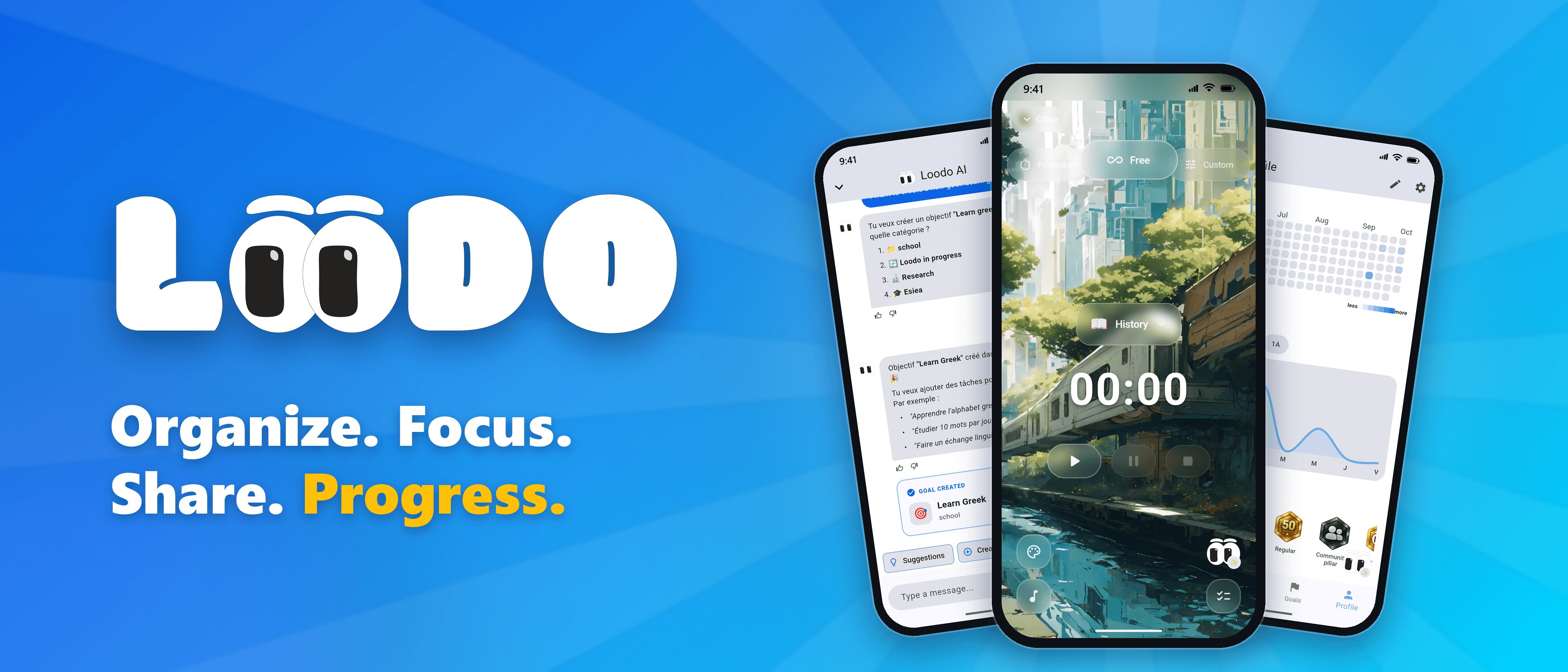
A social productivity app — a Strava for work — whose AI coaching agent performs real in-app actions instead of only talking about them.

Loodo AI is a planning assistant running on Mistral through tool calling: instead of answering with advice, it calls the app's own operations to create goals and tasks, tick them off and read your progress. I also prototyped an on-device coach by fine-tuning Mistral 7B with QLoRA (Unsloth), to see how much of the experience survives without a network call. One Flutter codebase runs on iPhone, Android and the web, backed by Supabase.

Loodo

Project notesloodo.app

Team project on a de-identified oncology cohort

Built with
Python, pandas, scikit-learn, missForest / MICE

Endocrine therapy toxicity prediction

Predicting one-year toxicities of breast cancer endocrine therapy, on a cohort of 2,115 patients and 199 variables.

The interesting work here was upstream of the model. I established the missing-data mechanism (missing at random), benchmarked missForest against MICE for imputation, and restricted the cohort to patients with an observed target — so that the label is never imputed and the evaluation stays honest.

Project notes

Methods and training

Machine learning
PyTorch, TensorFlow / Keras, Hugging Face Transformers, scikit-learn, Unsloth / QLoRA
Recommendation
Prod2Vec, Meta-Prod2Vec, StarSpace, negative sampling, Gensim (Word2Vec / SGNS), UMAP, spectral clustering
On-device and edge
TFLite / LiteRT, LiteRT-LM, MediaPipe, Gemma, Android (CameraX)
Data and tooling
pandas, NumPy, missForest / MICE, Supabase, Flutter, Google ADK, Git
Programming
Python, SQL, Dart
Spoken
English (professional), French (native), Chinese (beginner)

Education

ESIEAParis, France

Engineering degree (Master level), major in Artificial Intelligence & Data Science. Expected September 2027.

Tamkang UniversityNew Taipei, Taiwan

Computer Science & Information Engineering, university exchange. Coursework in mathematics for machine learning.

Beyond the lab

Co-Lead, GDG on Campus ESIEA (Google Developer Group)

GDG on Campus is Google's network of student developer chapters, and I launched the one at ESIEA. We run talks, workshops and hackathons — I gave the opening talk, on AI agent architecture, and ran the hands-on workshop alongside it. The chapter exists to give motivated students somewhere to be seen: a hackathon is one of the few settings where someone with no title and no publication can show what they are actually able to build, in front of people who will notice.

The chapter on gdg.community.dev

References

  • Interested and interesting, Ludovic knew how to push forward and see his projects through.
    Emmanuel PerezComputer science lecturer at ESIEA, EPITA graduate
  • A serious, pleasant and self-reliant student with a solid capacity for work. He followed my Python courses diligently, and it was a real pleasure to support his progress.
    Antoine LeblancPhD student in XAI for cybersecurity and lecturer at ESIEA
  • A friendly, curious student with a real interest in development.
    Zequan HuangPhD candidate and lecturer at ESIEA, cybersecurity engineer